
Lead the Learning Before You Lead the Change
Sarah McFarland has been pitched every AI tool under the sun. What she's building at Visions In Education starts somewhere else entirely.
Every week, a vendor lands in Sarah McFarland's inbox with the latest, can't-miss AI tool. As Director of Educational Technology at Visions In Education — a free TK–12 charter school serving over 8,000 students across Northern California, in person and online — she could fill her calendar taking those meetings. She mostly doesn't.
"AI Readiness is not about chasing a technology trend," she says. "It's not about the latest tool. It’s about the learning, the critical thinking, and having teachers teach each other."
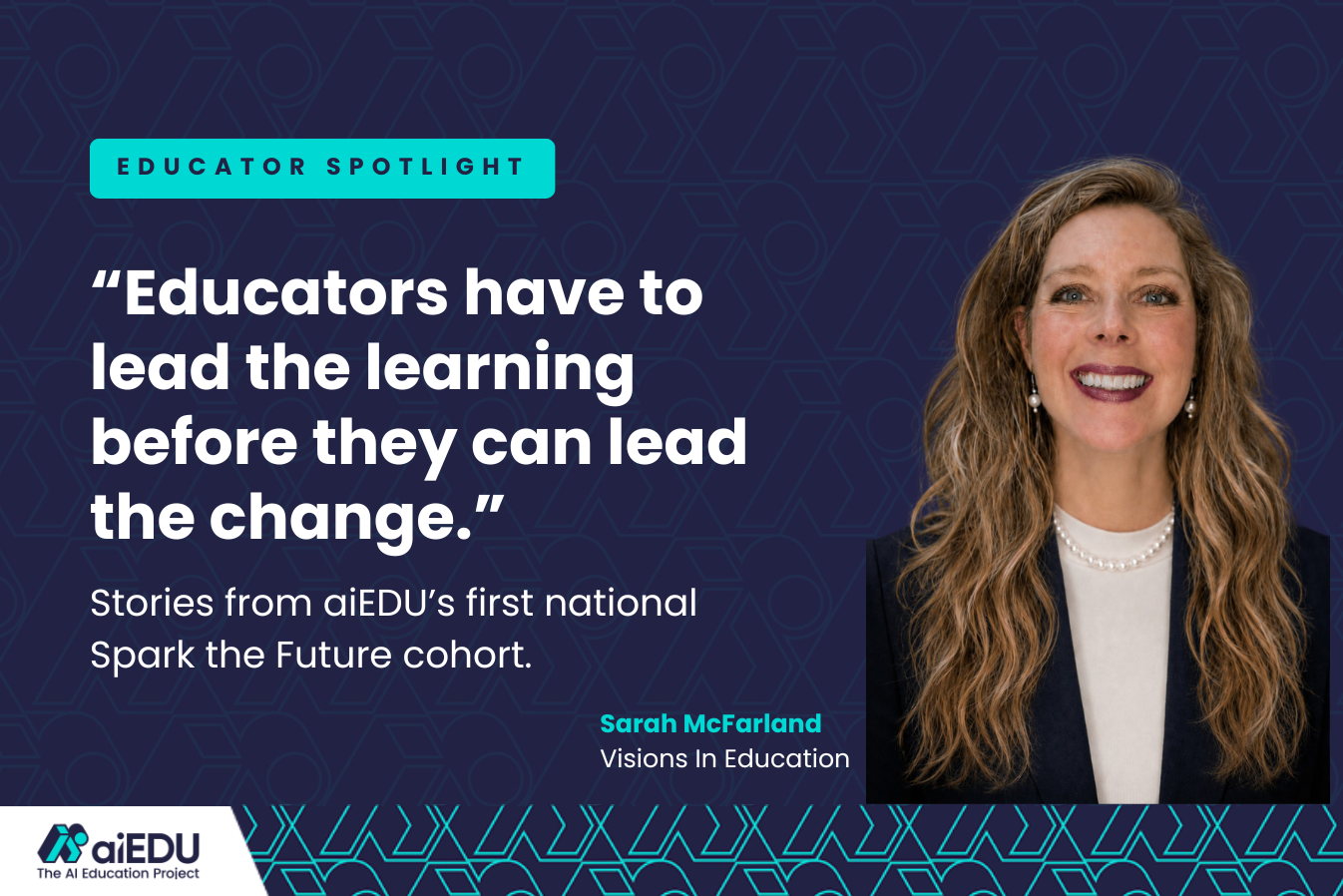
For McFarland, the shiny object is a distraction from the real work — and the real work is about people, helping educators build the judgment to use AI well, and teaching students to do the same. It's a conviction she returns to in a single phrase: “Educators have to lead the learning before they can lead the change.”
That's the spirit aiEDU's Spark the Future program is built to draw out. The cohort — aiEDU's first national train-the-trainers effort — gathers teachers and school leaders from across the country to work through a shared AI literacy course, then build a plan to bring the content and training back to their work. The focus isn't on tools, but on the durable skills an AI-shaped world rewards — critical thinking, judgment about when and how to lean on AI, and the uniquely human capacities a machine can't replace. McFarland, a former special education teacher turned ed-tech leader with an AI certification from UC Berkeley, is exactly who it was built for: a seasoned educator eager to keep learning, to do it alongside peers, and to bring it straight back to her teachers and students.
Back at Visions In Education, McFarland is taking what she learned to build a system to train other educators on AI literacy — a way to meet them where they are and build real judgment before introducing any tools. Each Spark the Future participant receives 30 seats in the Teach for Tomorrow course to share with their own teachers; because McFarland brought a team of three, including the manager of Curriculum & Instruction and a teacher, Visions has 90 seats. The school is creating opportunities for teachers to strengthen their AI literacy through exploring the modules, and collaborating through their professional learning communities. The school is also building one AI literacy lesson a month, K–12, grounded in aiEDU's frameworks so every student gets the same foundation.
The moment that clicked for her in the cohort wasn't about a tool. One activity walked participants through a set of personas — a spectrum of the perspectives people bring to AI, from enthusiasts to resistors — and named something she'd felt for years. "You can't just dive right into the tools," she says. "You have to slow down and actually talk about what your perspective is, why it's important." AI Readiness, in her telling, is cultural before it's technical.
It's also, she insists, a matter of equity. A school survey found 98% of Visions students already using AI. "It's already happening," she says. "As educators, we're being called to step up and lead." Every student deserves access to those skills — using AI thoughtfully, questioning what it produces, and knowing when their own judgment should override it — embedded in the curriculum rather than left to chance. At Visions, that means an "AI truth and transparency" practice where teachers tell students up front how AI may be used on an assignment — "a conversation, not an accusation."
Ask her what she'd tell an educator who doesn't feel ready to engage with AI yet, and she has a three-part answer: learn the tools by actually using them, listen to colleagues and podcasts and webinars, and only then lead — keeping the focus on literacy for adults and students, not on clicking buttons. "You can't just jump into leading," she says, "if you haven't done the first two parts first."
Where that can lead is already visible at Visions, which runs one of just two high school AI career pathways in California — students earn college credit toward an AI certificate, learning Python and the difference between predictive and generative systems.
If she wishes one thing for the field, it's less isolation. "So many of us are trying to recreate the wheel by ourselves," she says — when what's needed are spaces to trade what works and be honest about what doesn't. That's exactly what Spark the Future set out to build: a national network where educators learn the same skills, then keep learning from each other long after the sessions end. It's the same instinct behind everything she builds: the people closest to the work already have what they need. The job is to give them room to lead.
