Teacher Spotlight: Kelsey Gillespie
Kelsey Gillespie didn't come to AI looking to become an innovator. She came looking to learn, and ended up becoming exactly the kind of educator her students and colleagues needed.
Kelsey is a third grade teacher at Perkins Local School District in Ohio and an aiEDU Trailblazer Fellow. What started as a search for breathing room in a demanding year turned into something much bigger: a classroom transformed, a school more equipped, and a teacher fully in her element.
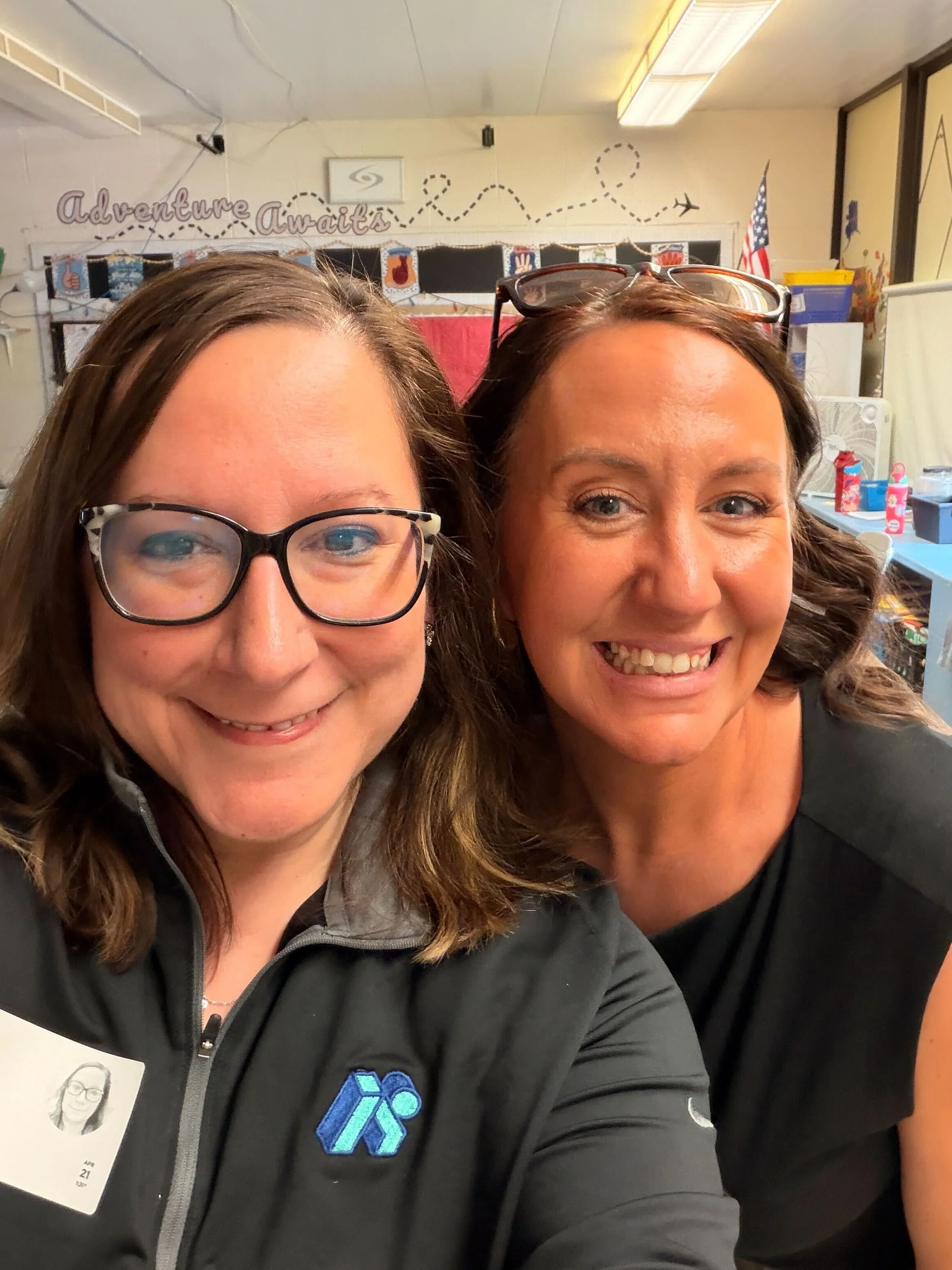
Kelsey’s classroom got a surprise visitor!
aiEDU’s Kristen Kayser visited Kelsey’s classroom in April.
In her own words:
"AI gave me my teacher spark back.
I was having the kind of year that makes you question everything. My classroom was bursting with students who had more needs than I could meet as just one person. I felt like I was drowning in grading, family communication, lesson planning, and data analysis. I was overwhelmed and stressed, looking for something, anything, that could help me check off a to-do list that never seemed to end.
Then I attended aiEDU's AI Summit. I had no idea what AI really was, but it counted for PD hours, and honestly, I needed a reset. The keynote speaker, Rebecca Bultsma, was amazing. She wasn't there to sell some magical solution or make me feel guilty about struggling. She was passionate, practical, and gave me tools I could use immediately.
So I sat there at the conference and tried them. I used ChatGPT to write a field trip chaperone note. I used Gemini to create a rhyme to help my students remember the difference between area and perimeter. I used Suno to create a song about fractions.
That day changed everything.
I dove into the world of AI headfirst. I completed coursework for my computer science endorsement. I started leading professional development sessions showing other teachers how to use AI. I even ended up on a panel at the Northwest Ohio AI Summit, the very type of conference that started it all.
I wanted to go deeper, to really understand how to teach AI literacy to my students and not just use AI as a productivity tool. That's why I applied to be an aiEDU Trailblazer Fellow.
Now I'm collaborating with educators across the Midwest who are learning alongside me. We're teaching our students what AI actually is and how to use it responsibly. My students are engaged, and they're thinking critically about what AI is now and what it could mean for their futures.
During our first 'What is AI?' exploration, students had to sort items into 'AI' and 'not AI' categories. What started as a simple categorization activity turned into a debate about edge cases. 'What if the light switch is hooked up to an Alexa to turn it off and on?' one student asked. 'Is it AI now, or is it still just a light switch?' These are the kinds of questions I never imagined my elementary students would be wrestling with, and they were so into it.
I'm not a tech genius. I'm a teacher who needed help and found it. Now I'm leading PD sessions, sitting on panels, and watching my elementary students debate the nuances of artificial intelligence with genuine curiosity and critical thinking. AI gave me my spark back — and now it's giving my students tools to understand and shape the world they're inheriting. That's what makes this work so powerful, and that's why I'm all in."
Kelsey's path, from overwhelmed classroom teacher to Trailblazer Fellow leading professional development across her district, is not unusual in our network. What we see again and again is that when a teacher gets the right support at the right moment, they don't just change their own practice. They bring other teachers with them.
That ripple effect is the whole point. AI readiness doesn't happen through a mandate or a one-time training. It happens because someone like Kelsey shows up to a conference on a hard year, tries something new, and decides to keep going.
To every teacher doing that right now, thank you. You are the reason this work moves.
Want to follow Kelsey's lead?
Learn more about the aiEDU Trailblazer Fellowship and how to bring AI readiness to your classroom and school.