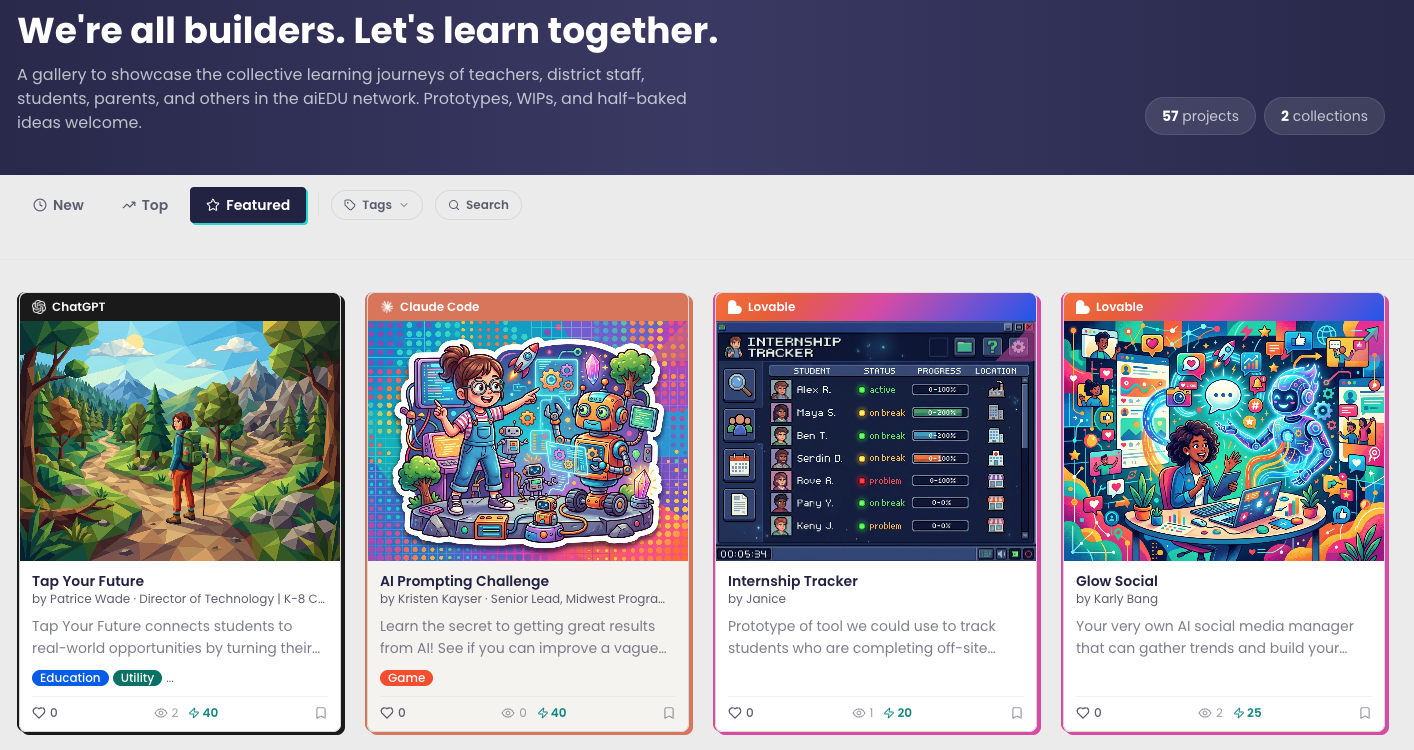
Explore aiEDU's growing Vibe Coding Gallery and see what happens when educators start building with AI: vibecoding.aiEDU.org
Something powerful is happening when educators realize they don't need to know how to code to start building with AI. At aiEDU, our Vibe Coding workshops have quickly become some of our most talked-about learning experiences, making AI feel practical and immediately accessible.
What is Vibe Coding?
Vibe coding is the practice of using natural language instead of traditional programming languages to build simple tools, resources, and prototypes with AI.
Instead of writing complex code, educators can simply use plain English to describe what they want and AI helps bring it to life. For many, that shift has been a breakthrough.
A movement growing faster than expected
Over the past several weeks, aiEDU has led vibe coding workshops with hundreds of participants, including:
School leaders across New York City Public Schools
A theater filled with college and career counselors
The largest workshop space at SXSW
Nearly 40 philanthropy leaders at ASU+GSV Summit
Check out CEO, Alex Kotran's Substack post Insights from 7 Vibe Coding Workshops in 4 Weeks
The vast majority of these participants had never written a single line of programming code before. Yet many left having built something of their own.
The momentum keeps building. In early April, we hosted Vibe Coding 101: Building Educator Tools with Natural Language, a webinar that drew strong participation from educators eager to understand how AI can help them create, not just consume.
One thing we know for sure: Educators want more. To capture the momentum, we've built a community gallery to highlight what educators are creating through vibe coding.
See what educators are building! Explore the growing Vibe Coding Gallery and see what happens when educators start building with AI:
👉 Visit the gallery at vibecoding.aiEDU.org
What it looks like when a teacher builds something real
The gallery isn't a collection of experiments for the sake of it. The tools educators are building solve problems they've been sitting with for years.
Take Leah Aiwohi, a teacher at Kauai High in Lihue, Hawaii, and an aiEDU Trailblazer Fellow. Leah built Ho'oulu Keiki — an AI-powered platform that tackles something unglamorous but genuinely important: school lunch. The app uses a conversational chatbot to gather student preferences, dietary needs, and activity levels, then turns that input into USDA-compliant menu recommendations for school administrators — ones that pull from local Hawaiian agriculture.
She had no programming background. What she had was a clear problem, a community she cares about, and a workshop that gave her the tools to act on it.
That's what keeps showing up across the gallery. Educators aren't building for novelty. They're building because there's a gap between the decision-makers and the people most affected — and they finally have a way to close it.
Why this matters more than the tools
Leah's project is impressive. But we're not expecting every teacher to ship an AI-powered school lunch platform. That's not the point.
The point is what happens to a person when they sit down with a frontier technology and decide to figure it out anyway.
Vibe coding puts educators in an unfamiliar place on purpose. There's no script, no step-by-step tutorial that covers every situation, no guarantee the thing you're building will work the first time. You have to describe what you want, watch what comes back, decide if it's right, and keep going. That process, not the finished product, is where the real learning happens.
That's what we mean when we talk about the human advantage. Not a list of skills that AI can't replicate. Not a defensive argument for why teachers still matter. Something more active than that: the ability to stay curious when things get confusing, to make judgment calls in ambiguous situations, to know what you're actually trying to solve before you ask a tool to solve it. Leah didn't build Ho'oulu Keiki because she knew how to build apps. She built it because she understood her students, her community, and a problem worth solving. The technology followed her thinking, not the other way around.
There's something important about educators experiencing this in real time, alongside their peers and eventually their students. Teaching in the age of AI isn't just about curriculum. It's about modeling what it looks like to be a learner when the ground keeps shifting. How do you stay useful when the tools change every six months? How do you keep going when something doesn't work? How do you know when to trust an output and when to push back on it?
Those are the questions vibe coding forces you to sit with. And right now, teachers working through them together is the most honest version of AI professional development we've found.
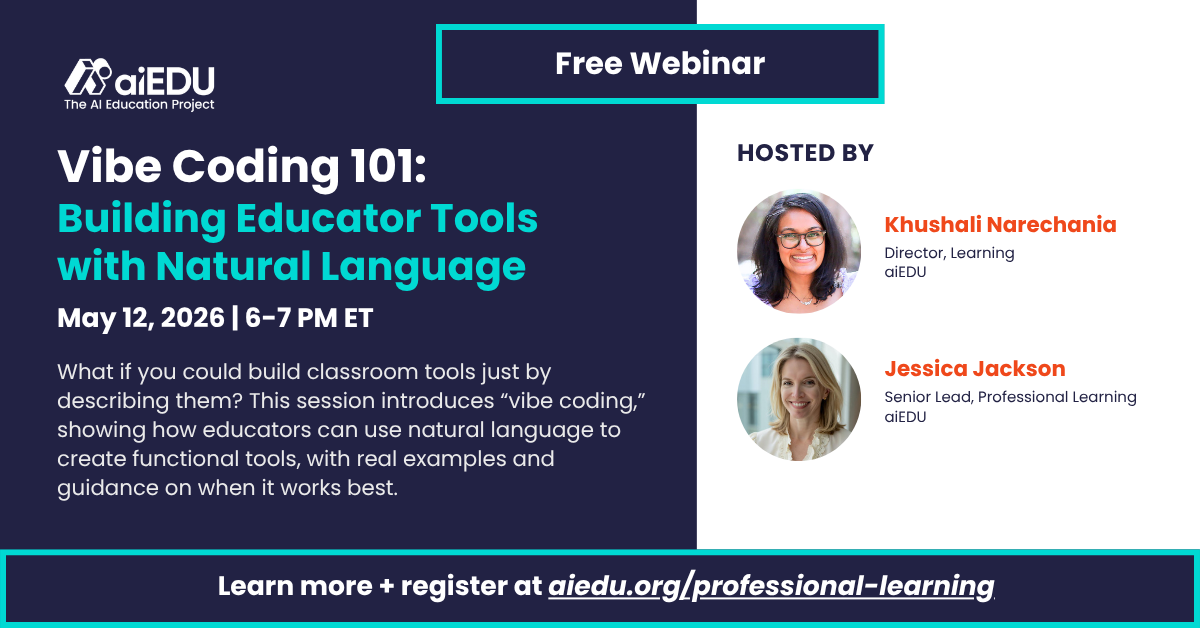
Save your sport for May 12!
Check out aiEDU.org/professional-learning
Because the first session filled quickly, Vibe Coding 101 is back by popular demand on Tuesday, May 12.
If you've been curious about how AI can help educators create tools using natural language, this next session is worth your time.
Save the date: May 12, 2026 — Vibe Coding 101: Building Educator Tools with Natural Language